
 Remember blowing into Nintendo cartridges to make them work?
That was our version of IT support.
Didn’t load? Blow on it.
Still didn’t work? Blow harder.
Last resort? Smack the console.
At the time, it felt like we knew what we were doing.
Fast forward to today.
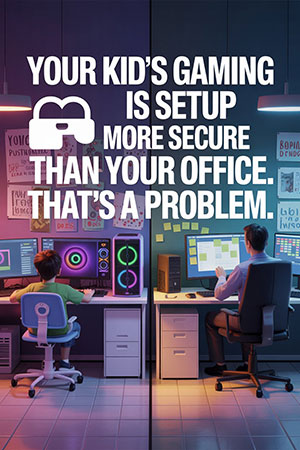
Your kid’s gaming setup has:
- Solid-state storage
- High-end processing power
- Mesh Wi-Fi with no dead zones
- Automatic updates
- Multi-factor authentication on every account
- Real-time performance monitoring
It’s optimized. Maintained. Protected.
Now think about your office.
For many businesses across Carmel and the Greater Indianapolis area, it looks more like this:
- A workstation that takes minutes to boot
- A printer that jams like clockwork
- Shared folders named “Final_FINAL_v3”
- Software that doesn’t integrate
- Wi-Fi that drops in the conference room
- Updates that have been ignored for weeks
Gamers optimize.
Businesses tolerate.
And that gap is more expensive than it looks.
Why Gamers Get This Right (and Businesses Don’t)
This isn’t about budget.
A well-built gaming setup often costs about the same as a business workstation.
Business internet is usually faster.
Security tools are widely available.
The difference is attention.
Gamers update everything immediately.
- Operating systems
- Drivers
- Firmware
- Applications
Why?
Because outdated systems cause lag.
And lag matters.
In business, those same delayed updates represent known security vulnerabilities — fixes that already exist but haven’t been applied.
Backups, Monitoring, and the Things Businesses Skip
Gamers back up their data religiously.
Lose a 200-hour game once, and it never happens again.
Meanwhile, many small businesses — including healthcare practices, law firms, and financial offices — either:
- Don’t have a documented backup process
- Don’t test their backups
- Or assume everything is “probably fine”
When a gamer loses data, it’s frustrating.
When a business loses data, it’s:
- Client records
- Financial history
- Case files
- Patient information
That’s not inconvenience. That’s operational risk.
Gamers also monitor performance constantly.
They track:
- System temperature
- Network latency
- Performance dips
They notice problems before they become failures.
Most businesses?
They find out when someone says:
“The internet’s slow today.”
That’s not monitoring.
That’s reacting.
How Business Technology Gets This Way
No one designs a messy system on purpose.
It happens gradually.
A tool gets added to solve a problem.
Another gets layered in for accounting.
Another for CRM.
Another for file sharing.
Another for security.
Each decision made sense at the time.
But over time, systems stop being designed — and start being accumulated.
That accumulation creates:
- Redundancy
- Friction
- Gaps in security
- Inefficiencies across teams
Gaming setups are optimized intentionally.
Business systems often evolve accidentally.
And accidental systems become expensive systems.
The Cost Nobody Tracks
This doesn’t show up as a major outage.
It shows up in small, daily moments:
- Waiting for systems to load
- Searching for files
- Re-entering data
- Restarting devices
- Working around “how things are”
Individually, these feel minor.
But they add up.
Every interruption breaks focus.
Every delay slows momentum.
Across a team, over time, that becomes:
- Lost productivity
- Frustrated staff
- Slower client service
- Reduced profitability
In gaming, lag is unacceptable.
In business, it becomes normal.
And “normal” is where the cost hides.
A Better Question to Ask
Most business owners say:
“Our technology works fine.”
But “working” isn’t the same as working efficiently.
Ask yourself:
- Are your systems integrated — or just coexisting?
- Are your tools supporting your workflow — or creating workarounds?
- Is your network monitored proactively — or only when something breaks?
Today, performance isn’t driven by hardware alone.
It’s driven by:
- Systems
- Automation
- Security
- Process design
And none of that improves on its own.
A Quick Reality Check
Try this:
- Do you know how old your oldest device is?
- Do you know if your backups ran successfully last week?
- Are there devices with pending updates right now?
- Do you know your network performance without checking?
Your kid could answer all of those about their gaming setup instantly.
If you can’t answer them about your business, that’s not a failure.
It just means no one’s been asked to pay attention to it yet.
Managed IT Services in Carmel, IN: From Accumulation to Optimization
Businesses that run efficiently don’t necessarily have more technology.
They have better-aligned technology.
That means:
- Systems that work together
- Devices that are maintained and updated
- Networks that are monitored
- Processes that reduce friction instead of adding to it
The goal isn’t more tools.
It’s fewer problems.
A Practical Next Step
If your systems are already streamlined, monitored, and working together — that’s great.
But if parts of your technology feel like they’ve been “good enough” for a while, it may be time to take a closer look.
👉 Schedule a free 15-minute discovery call to:
- Identify where friction is slowing your team down
- Review gaps in updates, backups, and monitoring
- Find simple ways to improve performance without overhauling everything
No jargon.
No pressure.
Just a practical conversation.
Because in business — just like in gaming — performance matters.