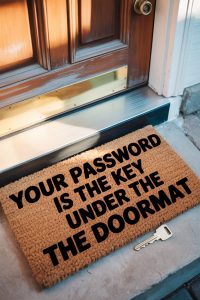
 Picture walking up to a house and finding the spare key under the welcome mat.
Convenient? Absolutely.
Secure? Not even close.
Unfortunately, many small businesses in Carmel and the Greater Indianapolis area treat passwords the same way.
Not intentionally.
Just habitually.
And for healthcare practices, financial firms, and law offices handling sensitive client data, those habits create more risk than most people realize.
The Real Problem Isn’t Weak Passwords. It’s Reused Ones.
Most security breaches don’t start inside your business.
They start somewhere else entirely:
- A shopping website
- A food delivery app
- An old subscription account no one remembers creating
That company gets breached, and suddenly your email and password are floating around the dark web.
From there, attackers use automated tools to try those same credentials everywhere:
- Email accounts
- Microsoft 365
- Banking portals
- Cloud storage
- Practice management systems
- Financial software
One reused password can quickly become access to your entire business.
For professional firms in Carmel and Indianapolis, that can mean exposure of:
- Patient information
- Financial records
- Legal documents
- Internal communications
And it happens faster than most people think.
Why Credential Stuffing Works So Well
This type of attack is called credential stuffing.
It’s not sophisticated.
It’s automated.
Software tests stolen usernames and passwords across hundreds of systems while everyone is asleep.
And because password reuse is so common, it works.
Research consistently shows that most people reuse passwords across multiple accounts. That means one compromised login can unlock far more than intended.
Think of it like carrying one physical key that opens:
- Your house
- Your office
- Your car
- Every locked door you own
Lose it once, and everything becomes accessible.
That’s what password reuse does.
Strong passwords protect individual accounts.
Unique passwords protect the business.
“Strong Enough” Isn’t What It Used to Be
Many businesses still think password security means:
- One capital letter
- One number
- One symbol
That might have been enough years ago.
It isn’t anymore.
Modern password attacks don’t involve someone manually guessing your login.
They involve software testing billions of combinations automatically.
A password like:
P@ssword1!
…gets cracked quickly.
Longer passwords or passphrases are significantly better.
But even that misses the larger point:
A password alone is no longer enough protection.
One phishing email.
One compromised vendor.
One sticky note on a desk.
That’s all it takes.
Relying on passwords alone is an outdated security strategy.
Multi-Factor Authentication Is the Deadbolt
If your password is the lock, multi-factor authentication (MFA) is the deadbolt.
MFA requires:
- Something you know (your password)
- And something you have (a phone prompt or authentication app)
So even if someone gets the password, they still can’t access the account.
For healthcare, financial, and legal firms, MFA is no longer optional.
It’s increasingly expected by:
- Cyber insurance providers
- Compliance standards
- Clients who expect secure handling of their information
And yet many businesses still haven’t fully implemented it across all systems.
Password Managers Solve the Human Problem
Here’s the reality:
People reuse passwords because they’re busy.
They forget them.
They simplify them.
They take shortcuts.
That’s normal human behavior.
Good security systems account for that instead of pretending people will suddenly become perfect.
Password managers like:
- 1Password
- Bitwarden
- Dashlane
…generate and store unique passwords for every account.
That means:
- No repeated credentials
- No sticky notes
- No shared spreadsheets of passwords
- No “I use the same password everywhere because I can remember it”
Every system gets its own key.
And none of them live under the welcome mat.
Why This Matters for Professional Practices
For healthcare practices in Carmel, password problems can become HIPAA problems.
For financial firms, they can become trust and compliance issues.
For law offices, they can expose confidential client communications.
Most cyberattacks against small businesses don’t require advanced hacking.
They require:
- Weak systems
- Reused credentials
- One rushed employee
- One missing layer of protection
That’s why cybersecurity today is less about creating perfect employees — and more about building systems that protect the business when people make normal mistakes.
Because people will:
- Reuse passwords
- Click things too quickly
- Ignore update reminders
- Forget security steps
Strong systems assume that and reduce the risk anyway.
A Quick Password Reality Check
Ask yourself:
- Are employees still reusing passwords?
- Is MFA enabled on every critical account?
- Are passwords stored securely — or scattered across notes and browsers?
- Would you know if credentials had already been exposed in a breach?
If you’re unsure, you’re not alone.
Most small and mid-sized businesses haven’t revisited password security in years.
Managed IT and Cybersecurity Services in Carmel, IN
Well-run businesses don’t rely on memory and good intentions to protect sensitive information.
They build systems that reduce risk automatically.
That includes:
- Password managers
- Multi-factor authentication
- Access controls
- Ongoing monitoring
- Employee cybersecurity awareness
The goal isn’t paranoia.
It’s making sure one compromised password doesn’t become a business-wide problem.
A Practical Next Step
If your business already uses password managers and MFA across all critical systems, that’s excellent.
You’re ahead of many businesses your size.
But if password security still relies mostly on “everyone being careful,” it may be time for a quick review.
👉 Schedule a free 15-minute discovery call to review:
- Password security risks
- MFA coverage gaps
- Credential management practices
- Simple ways to strengthen security without slowing people down
No scare tactics.
No pressure.
Just practical guidance.
Because good cybersecurity doesn’t depend on people being perfect.
It depends on systems designed to protect the business anyway.