
Mike Tyson famously said, "Everyone has a plan until they get punched in the mouth."
It's a memorable quote because it's true well beyond the boxing ring.
In business, that "punch" might be a server failure, a ransomware attack, a power outage, or an employee accidentally deleting critical data. These events rarely happen when it's convenient, and they often expose assumptions that have gone unchallenged for years.
Most business disruptions aren't caused by a complete lack of preparation. They're caused by believing something is working without ever verifying it.
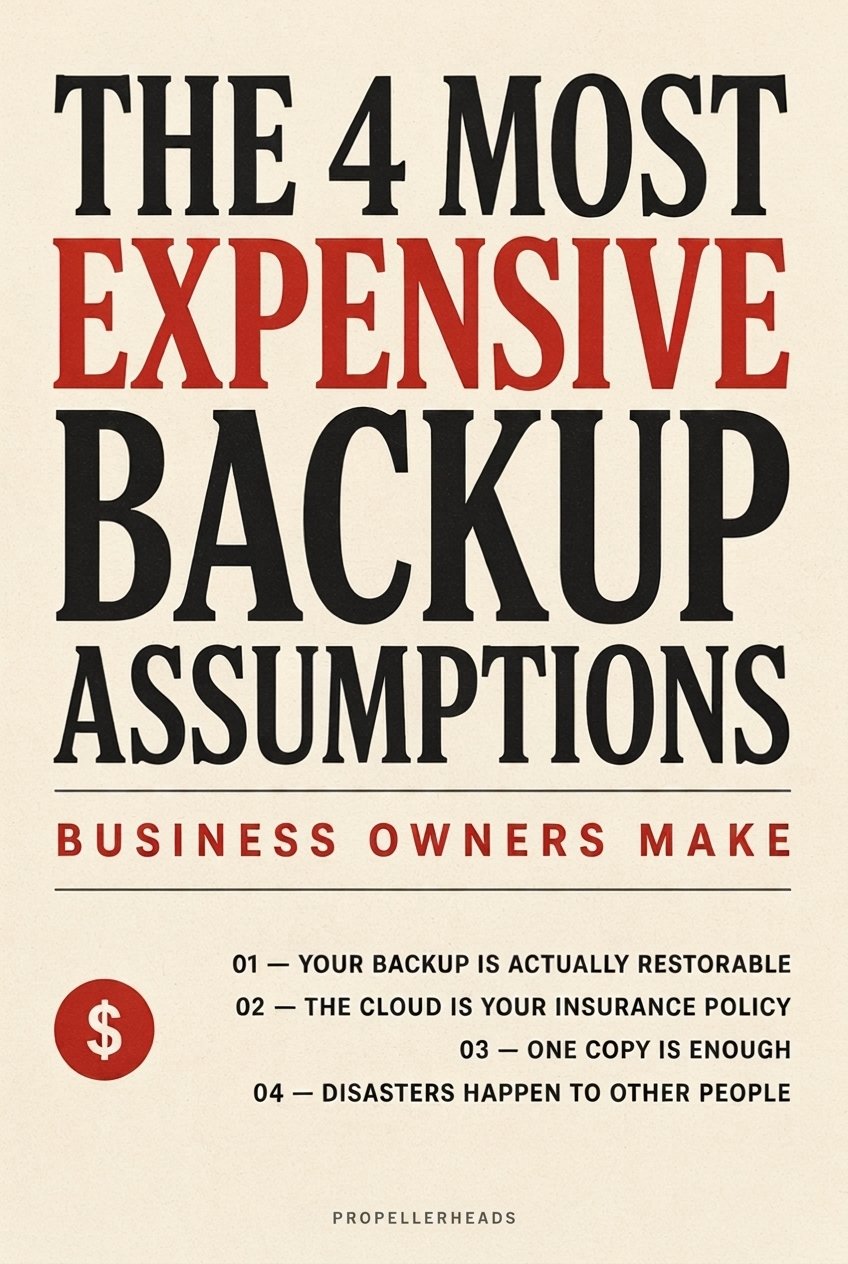
Here are four assumptions we see most often--and why they can become expensive.
Assumption #1: "We're Backed Up"
Many business owners feel confident because they know backups are running.
That's a good start, but it's only part of the story.
The real question is whether those backups can actually be restored quickly and completely when your business needs them.
Think of it like keeping a spare tire in your vehicle. Having one provides peace of mind--unless you discover it's flat when you're stranded on the side of the road.
Backups work the same way.
You may receive daily success notifications and see reassuring green checkmarks in a dashboard, but none of those confirm that your business can recover from an actual outage.
A recovery test answers the questions that matter:
- How long would it take to restore your systems?
- Are all of your critical applications included?
- Has anything been added to your business that isn't being protected?
- Can your employees continue working during the recovery process?
A backup only proves its value when it successfully restores your business operations.
Assumption #2: "Someone Will Tell Us if Something Goes Wrong"
Modern monitoring tools are incredibly valuable.
They can detect suspicious activity, identify failing hardware, and alert you when something isn't operating as expected.
But alerts alone don't solve problems.
Imagine receiving a weather warning about a severe storm. The forecast gives you valuable information, but it doesn't secure your building, protect your equipment, or execute your emergency plan.
Technology monitoring works the same way.
Knowing there's a problem is important.
Having a documented process for responding quickly is what minimizes downtime and limits the business impact.
The faster your team can move from detection to action, the more resilient your business becomes.
Assumption #3: "Our Team Knows What to Do"
Every organization believes its people will respond well in a crisis.
Until they're forced to.
Picture a Friday afternoon when a critical application suddenly becomes unavailable.
Who contacts your IT provider?
Who communicates with employees?
Which systems need to be restored first?
Who updates customers if service is interrupted?
Without a documented recovery plan, even experienced teams spend valuable time deciding what to do instead of actually solving the problem.
That's why businesses practice emergency procedures.
Nobody conducts a fire drill because they expect a fire tomorrow.
They practice because emergencies are the worst time to figure out who's responsible for what.
Your technology recovery plan deserves the same level of preparation.
When responsibilities are clear and recovery procedures have been tested, your team can focus on restoring operations instead of reacting under pressure.
Assumption #4: "It Won't Happen to Us"
This may be the most common assumption of all.
When your business is focused on serving customers, growing revenue, and managing daily operations, it's easy to believe major disruptions happen somewhere else.
The reality is that many business interruptions are surprisingly ordinary.
A failed hard drive.
An employee clicking a phishing email.
An internet outage.
A software update that doesn't go as planned.
These situations happen every day.
The businesses that recover most successfully aren't necessarily the ones that avoid disruptions altogether.
They're the ones that planned for them.
Preparation doesn't eliminate every problem, but it dramatically reduces the time, cost, and stress involved in responding.
Preparation Beats Assumptions Every Time
Business continuity isn't about expecting the worst.
It's about making sure your business can continue operating when the unexpected happens.
Testing your backups, documenting recovery procedures, reviewing your technology regularly, and understanding how your systems support your operations all contribute to a stronger, more resilient business.
The goal isn't perfection.
It's confidence.
Confidence that your data is protected.
Confidence that your team knows what to do.
Confidence that your business can recover quickly and continue serving your clients when challenges arise.
A Practical Next Step
If it's been a while since you've reviewed your backup and disaster recovery strategy, now is a great time to take another look.
Schedule a free 15-minute discovery call, and we'll walk through your current backup, recovery, and business continuity plans. Together, we'll identify what's working well, what has been tested, and where there may be opportunities to strengthen your overall preparedness.
No pressure.
No technical jargon.
Just a practical conversation focused on helping your business stay productive, resilient, and ready for whatever comes next.