
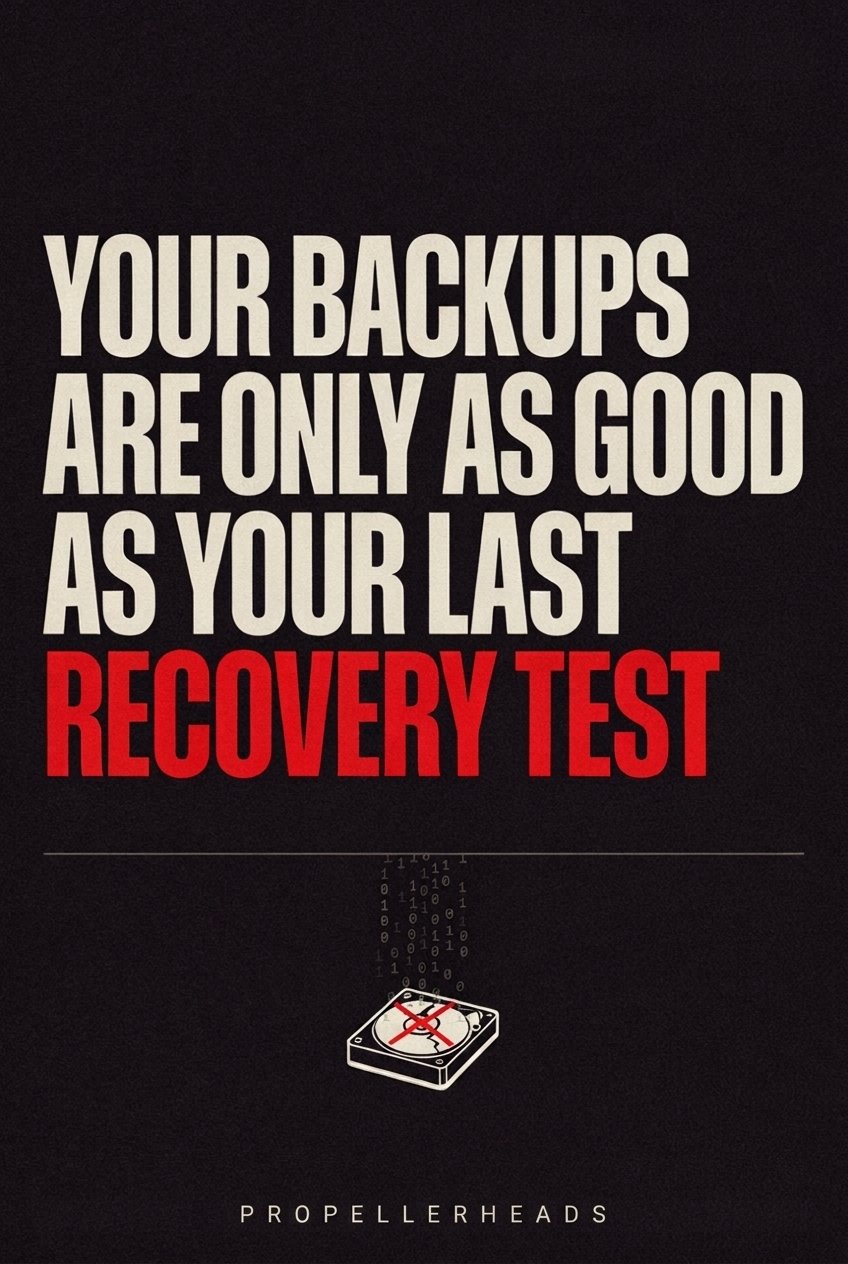
Most business owners feel confident knowing their data is backed up.
The real question isn't whether backups exist.
It's whether they will actually work when your business needs them most.
Think about fire drills in schools. Nobody waits until there's an actual emergency to figure out where students should go or who is responsible for getting everyone out safely. The plan is practiced ahead of time so that if an emergency ever happens, everyone knows exactly what to do.
Your backup and disaster recovery strategy should work the same way.
For healthcare practices, law firms, and financial firms throughout Carmel and the Greater Indianapolis area, regularly testing your ability to recover is just as important as creating the backup itself.
Why Practice Matters
Fire drills aren't designed to check a box.
They're designed to answer an important question before an emergency ever happens:
Will our plan actually work?
When people understand the process, know their responsibilities, and have practiced the steps, there's far less confusion when something unexpected occurs.
The same principle applies to your business technology.
Backups should never be based on assumptions. They should be based on verification.
Because if something isn't working properly, it's far better to discover it during a scheduled recovery test than during a ransomware attack, server failure, or accidental data loss.
Preparation removes uncertainty.
Having Backups Isn't the Same as Being Able to Recover
Many businesses have invested in backup solutions.
That's a great first step.
What often gets overlooked is the recovery process itself.
If a critical server failed tomorrow, how long would it take to restore your systems?
Which applications would come back first?
Would employees be able to continue working while recovery takes place?
Who would coordinate the process?
For many organizations, those questions don't get answered until systems are already offline.
That's when uncertainty becomes expensive.
An outage isn't simply an IT problem.
It's lost productivity, delayed client service, interrupted patient care, missed deadlines, and revenue that may never be recovered.
The longer recovery takes, the greater the business impact becomes.
What Recovery Testing Actually Looks Like
Recovery testing isn't a theoretical exercise.
It's a practical way to verify that your backup strategy will perform the way you expect.
A proper recovery test confirms that your backups can actually be restored, measures how long recovery takes, and identifies any systems that require additional attention before an emergency occurs.
It also helps answer important operational questions.
Can your most critical applications be restored quickly?
Are cloud-based systems included in your recovery plan?
Do backup procedures align with your current technology environment?
Has your business added new software or systems that aren't being protected today?
These are the kinds of questions businesses rarely think about until they're facing an actual outage.
Recovery testing provides those answers before the pressure begins.
The Hidden Cost of Untested Backups
One of the biggest misconceptions about backups is that simply having them eliminates risk.
Unfortunately, that's not always true.
Backups can fail. Storage devices can become corrupted. New applications may never have been added to the backup schedule. Recovery procedures may be outdated because your business has changed significantly over the past year.
Without regular testing, those issues often remain hidden.
Then an emergency occurs.
Employees are unable to access critical systems. Leadership is looking for answers. Customers and clients are waiting for updates. Every hour that passes increases the financial and operational impact.
What could have been a relatively minor disruption becomes a much larger business problem because no one knew the recovery plan had gaps.
The goal isn't just protecting your data.
It's protecting your ability to continue serving patients, clients, and customers.
A Recovery Plan Should Evolve With Your Business
Businesses aren't static.
Over time, new employees join the organization, cloud applications are adopted, workflows change, and additional systems become part of everyday operations.
Your backup strategy should evolve alongside those changes.
A recovery plan created two or three years ago may no longer reflect how your business operates today.
That's why reviewing and testing your recovery process should become part of your regular technology strategy rather than something that's only considered after an incident.
For regulated industries like healthcare, financial services, and legal practices, that level of preparation also supports business continuity, compliance efforts, and client confidence.
Don't Wait for an Emergency to Find the Gaps
Nobody schedules a fire drill because they expect a fire tomorrow.
They practice because an emergency is the worst possible time to discover the plan doesn't work.
The same is true for your backups.
If your recovery process hasn't been tested recently, you're relying on assumptions.
And assumptions have a way of becoming expensive at exactly the wrong time.
A Practical Next Step
If you're not completely confident that your business could recover quickly from a cyberattack, hardware failure, or accidental data loss, now is the right time to find out.
Schedule a free 15-minute discovery call, and we'll discuss your current backup and disaster recovery strategy, identify potential gaps, and help you determine whether your recovery plan is prepared for today's business environment.
No technical jargon.
No pressure.
Just a practical conversation about making sure your business can recover quickly when the unexpected happens.
Because backups are important.
Knowing they'll actually work is even more important.