
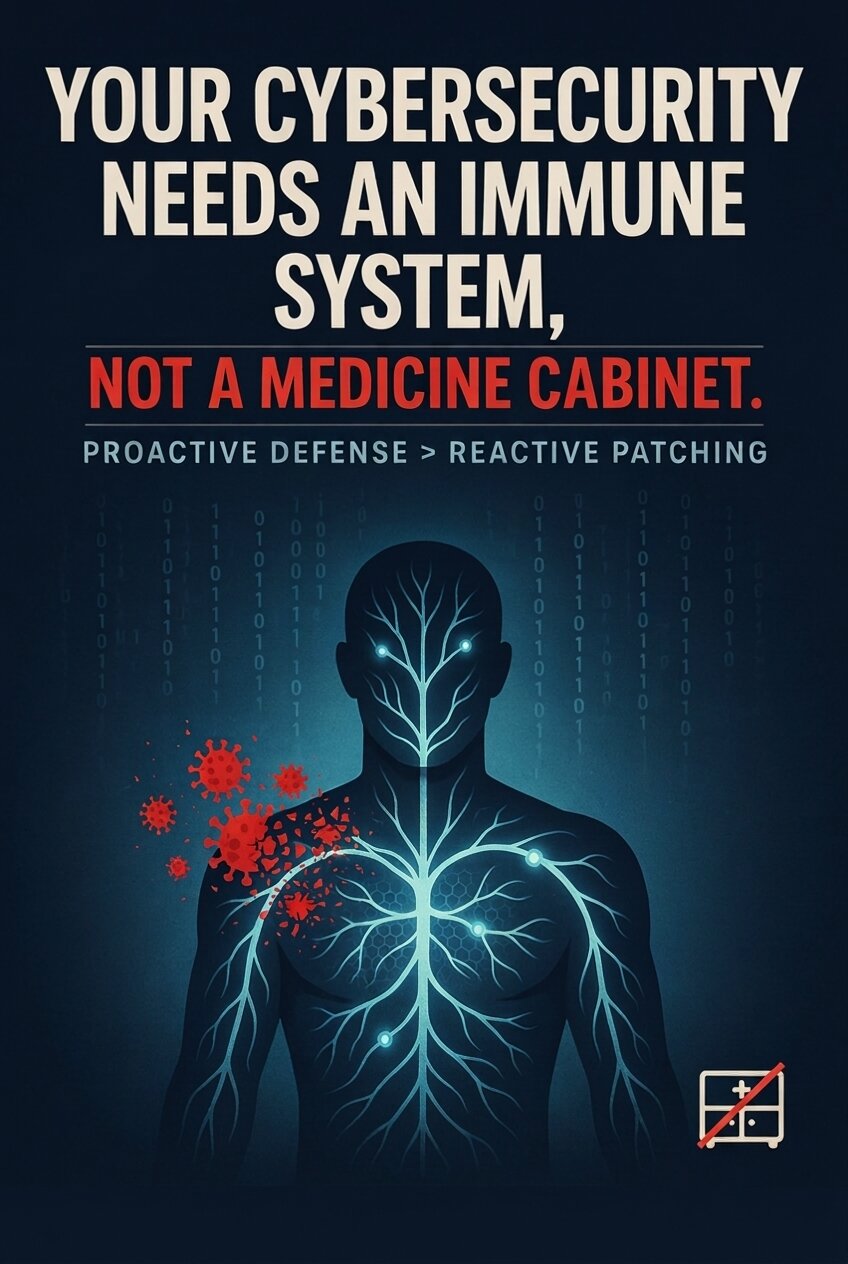
Every autumn, the medicine cabinet seems to get a little more crowded.
There's cold medicine left over from last winter, vitamins someone bought in bulk, half-used bottles of cough syrup, and probably something in the back that expired a long time ago.
There's plenty of medicine in there.
But nobody would look at a full medicine cabinet and assume the person who owns it must be incredibly healthy.
Businesses can fall into the same trap with cybersecurity.
A new threat leads to one purchase. A cyber insurance requirement leads to another. A vendor recommends something else. A compliance concern introduces another layer. Over time, the business accumulates an impressive collection of security products.
But having more cybersecurity tools doesn't automatically mean having better cybersecurity.
The more useful question is whether those tools, your employees, and your processes are working together as one coordinated system.
Cybersecurity Myth: More Tools Mean Better Protection
It's an understandable assumption.
If one cybersecurity product provides protection, adding another should make the business even safer.
Sometimes it does.
Layered security is an important concept because no single safeguard can protect against every possible risk. The problem begins when layers are added without considering how they fit together.
One tool may duplicate something another product already does. Another may generate alerts nobody is monitoring. A security feature the company is already paying for might never have been properly configured. Employees may have been given tools they don't understand or procedures they don't follow.
Meanwhile, an important gap somewhere else may remain completely unnoticed.
That's why cybersecurity shouldn't be measured by the number of products on an invoice.
The question isn't, "How many security tools do we have?"
It's, "Do we have the right protections for our business, and are they actually working together?"
Healthy Cybersecurity Works Like a System
Your immune system isn't a collection of unrelated defenses.
Different parts have different jobs, but they work together toward the same objective: identifying problems, responding appropriately, and protecting the larger system.
Cybersecurity should work in much the same way.
Technology is one part of it. Employee awareness is another. Access controls, backups, monitoring, policies, incident response procedures, and leadership all contribute to the larger picture.
When those pieces are coordinated, one layer can support another.
For example, security technology may identify a suspicious login attempt. Multi-factor authentication may make unauthorized access more difficult. An employee who recognizes an unusual authentication request may report it. Monitoring may help the IT team investigate what happened. A documented response process can then make sure the right people know what to do next.
No single one of those protections represents the entire cybersecurity strategy.
Together, they create a system.
That's the difference between accumulating security products and building a security program.
Cybersecurity Should Fit the Business You're Running Today
Another problem with the medicine-cabinet approach is that cybersecurity tends to accumulate over time.
Something gets added to solve a particular problem and then stays there.
Meanwhile, the business changes.
Employees join and leave. New applications are adopted. People begin working remotely. Vendors change. Offices move. Regulations and insurance requirements evolve. The organization starts handling information differently than it did three years ago.
But nobody goes back to ask whether the cybersecurity strategy evolved with it.
That's particularly important for healthcare practices, law firms, financial firms, and other professional organizations where employees regularly work with sensitive information.
The protections that made sense when you had eight employees in one office may not be the protections you need when you have 25 employees working from multiple locations and relying on several cloud applications.
Cybersecurity shouldn't be something you assemble once and leave alone.
It should evolve with the business.
Give Your Cybersecurity a Checkup
You don't need to understand every technical detail of every security product your company uses.
You should, however, be able to get clear answers to some basic business questions.
Start with what you're currently using and why.
Someone—whether that's an internal IT leader or your managed IT provider—should be able to explain the major safeguards protecting your organization in language you understand. More importantly, they should be able to explain why those protections make sense for your business.
Then ask where the layers overlap and where gaps might exist.
Overlap isn't necessarily bad. Some redundancy may be intentional and valuable. But there's a difference between deliberate layers of protection and paying for several products simply because they accumulated over time.
You should also know who's responsible for making sure everything is actually working.
A cybersecurity product can generate alerts 24 hours a day, but an alert doesn't accomplish much if nobody is reviewing it. A backup system isn't much comfort if nobody is testing whether data can be restored. Security software provides limited value if important features were never configured correctly.
Ultimately, someone needs to own the outcome rather than simply the tool.
And finally, ask when your cybersecurity strategy was last reviewed against the business you have today.
If nobody remembers, that's probably a good reason to have the conversation.
Your Employees Are Part of the System, Too
There's another reason cybersecurity can't be solved simply by adding technology.
People make decisions technology can't always make for them.
An employee receives an unusual payment request. Someone is asked to share sensitive information. A login prompt appears unexpectedly. A vendor sends new banking instructions. An email looks legitimate, but something about the request doesn't feel right.
Your cybersecurity tools may help in each of those situations.
But employees still need to know what to do.
That's why awareness training and practical security procedures belong in the same conversation as firewalls, endpoint protection, backups, and multi-factor authentication.
The objective isn't to make employees afraid of technology.
It's to give them clear expectations and a simple way to stop, verify, and ask for help when something doesn't look right.
Technology, people, and processes should reinforce one another.
More Cybersecurity Isn't Necessarily Better Cybersecurity
This is an important distinction for business owners.
The goal isn't to build the biggest cybersecurity stack you can afford.
It's to build the right one.
Sometimes that means adding a missing safeguard.
Sometimes it means properly configuring something you already own.
Sometimes it means eliminating unnecessary overlap.
Sometimes the biggest improvement has nothing to do with buying technology at all. It may mean testing backups, reviewing employee access, improving security awareness, documenting an incident response plan, or establishing a better process for verifying financial requests.
That's why a good cybersecurity conversation shouldn't automatically begin with a product recommendation.
It should begin with understanding the business.
Your IT Partner Should Be Able to Explain the Big Picture
A proactive IT partner should be able to step back from individual products and show you how everything fits together.
What are we protecting?
What are the most important risks?
Which safeguards address those risks?
Where are we relying too heavily on a single layer?
Where might we have unnecessary overlap?
What happens if one protection fails?
And how do we know everything is actually working?
For businesses in Carmel and throughout the Greater Indianapolis Area, particularly healthcare practices, law firms, and financial firms, those conversations can help turn cybersecurity from a collection of products into a more intentional business strategy.
You don't need another medicine cabinet full of things you may or may not need.
You need a system you understand and can have confidence in.
Take a Look at the Whole System
If your cybersecurity strategy has grown one product at a time over several years, it may be worth stepping back and looking at the bigger picture.
Schedule a free 15-minute discovery call with our team, and we'll talk about what you currently have in place, how it fits together, and where there may be opportunities to strengthen your approach.
No pressure. No scare tactics. And no assumption that the answer is buying another product.
Just a practical conversation about whether your cybersecurity strategy still fits the business you're running today.
Call us at 317-219-0408 or visit https://www.mypropellerheads.com/discoverycall/ to schedule your discovery call.